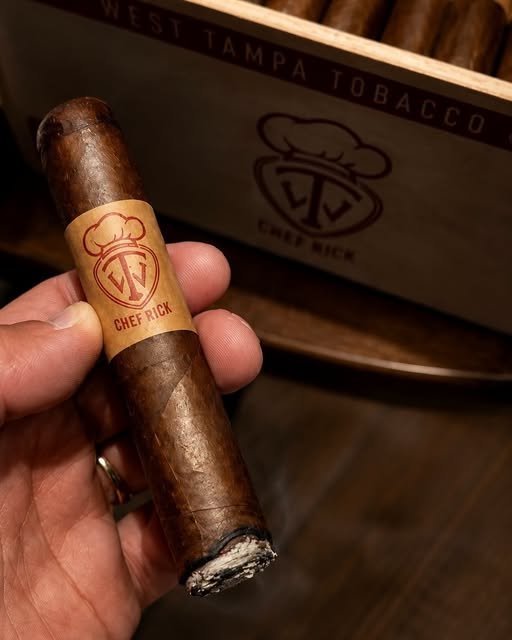
West Tampa Tobacco Co. has built enough goodwill that when the company releases something new, I’m interested. Chef Rick made that interest even stronger.
This isn’t just another extension of the regular West Tampa lineup. Chef Rick closes out the brand’s food-inspired trilogy, following Boliche Blvd. and Devil Crab. It’s a limited 6 x 52 Toro built around an Ecuador Habano oscuro wrapper, Ecuadorian Sumatra-seed binder, and Nicaraguan filler. At only 1,000 50-count boxes produced, that triggered my FOMO, so I had to try it out for myself.
On paper? There’s plenty to get excited about.
In practice, though, Chef Rick left me wanting more.
Not because it’s terrible. That would almost make this review easier. Instead, it sits in that frustrating middle ground where you can see pieces of a good cigar, but the whole thing never comes together.
Chef Rick makes a pretty solid first impression.
The construction gets most of the credit. At 4 out of 5, the cigar feels properly packed and put together with enough care that there’s little reason for concern before cutting it.
The wrapper is where some points disappear.
At 3 out of 5, it’s decent rather than gorgeous. And that’s fine. Cigars aren’t fashion models. A rough-looking wrapper can still hide an incredible blend underneath. the construction paper band gives it a rugged feel as well, so maybe that’s what they were going for?
Visually, Chef Rick starts on respectable footing.
Appearance Total: 7/10
And then things start to smell a bit off.
There’s nothing offensive here. There’s also nothing that makes me stop and think, Okay, this is going to be special.
The pre-light aroma earns a straight 3 out of 5. Pleasant. Serviceable. Middle of the road.
Once the cigar is burning, the aroma stays in roughly the same territory, earning another 3 out of 5.
That’s probably the best word for this part of Chef Rick: fine.
And “fine” can be dangerous in a cigar review. Bad gives you something to talk about. Great gives you something to remember. Fine just sort of…exists.
Aroma Total: 6/10
Here’s where the experience takes its first real hit.
Usually when i am comparing draw, I like to put the cigar head to head with something fromm their core line this time we were comparing to the West Tampa Red. The resistance here earns only 2 out of 5, making it one of Chef Rick’s weakest individual scores. A cigar can have incredible tobacco inside it, but if the airflow gets in the way, you’re fighting the mechanics instead of enjoying the blend.
That’s like buying good speakers and putting a blanket over them.
Consistency fares a little better at 3 out of 5, “and by that I mean it was consistently a tight draw” that isn’t giving this category any favors.
The draw isn’t disastrous. It just isn’t where it should be for a premium cigar carrying a $12.99 MSRP.
Draw Total: 5/10
We might have missed the bus to Flavortown
Flavor carries 20 points in our 90-point system for a reason. Construction matters. Burn matters. Presentation matters. But nobody sits outside for an hour because a cigar has a pretty wrapper.
We’re here for flavor.
And Chef Rick starts slowly.
The opening earns 2 out of 5. There isn’t enough happening early to make the cigar grab your attention. That’s especially disappointing because this is a cigar called Chef Rick. The culinary theme almost begs you to expect something expressive.
Then the middle arrives.
And it gets better.
Not great. Better.
The middle earns 5 out of 10, which puts it exactly halfway up the scale. There’s more character here than at the beginning, but the cigar still struggles to turn those ideas into something memorable.
Other smokers have reported notes ranging from cedar, oak, and baking spice to nuts, coffee, cocoa, and pepper. That’s an interesting menu. The problem with my score isn’t necessarily the absence of flavor; it’s how much enjoyment and development the cigar manages to pull from it.
The finish lands at 3 out of 5. It doesn’t completely fall apart, but there isn’t enough of a late surge to change the story.
Flavor Total: 10/20
And then we get to the roughest part of the cigar.
One out of five for burn evenness.
That’s brutal, but the score exists for a reason. When you’re spending your smoke correcting the burn rather than enjoying the cigar, something has gone wrong. Was it the cigar or user error? Well, as I’m writing the review here i’ll let you take a wild guess.
The ash earns 2 out of 5, so there isn’t much help coming from the other half of the category either.
This matters more than people sometimes admit. Burn problems break the rhythm of a cigar. Light. Puff. Relax. Talk. Sip your drink. That’s the rhythm.
Once the lighter keeps coming back out, the cigar becomes work.
And nobody asked Chef Rick to put us on the dinner shift.
Burn Total: 3/10
Strength is where things settle down again.
Chef Rick earns 3 out of 5 for body and another 3 out of 5 for nicotine strength.
That’s a clean 6 out of 10.
There’s enough presence to remind you that you’re smoking something substantial, but strength isn’t the defining feature of the experience.
And that’s completely okay.
More nicotine doesn’t automatically mean a better cigar. Sometimes Casual smokers fall into that trap: stronger must mean better, darker must mean stronger, huge ring gauge must mean more flavor. Cigars don’t work that neatly.
Chef Rick’s problem isn’t that it needs more muscle.
It needs more personality.
Strength Total: 6/10
This score tells you a lot about why the flavor section landed where it did.
Chef Rick earns only 2 out of 5 for flavor evolution. There simply isn’t enough meaningful progression across the smoke to keep pulling you forward.
Balance also gets 2 out of 5.
That doesn’t mean every puff is unpleasant. It means the pieces don’t come together well enough to create that satisfying sense of harmony you get from a great blend.
Think about an actual dish.
You can have excellent ingredients sitting on the same plate and still end up with something mediocre. The ingredients have to interact. Salt needs acid. Richness needs contrast. Texture matters.
Cigars aren’t food, obviously, but blending follows a similar idea.
Having flavors isn’t enough.
They have to work together.
Complexity Total: 4/10
Let’s talk Price.
The cigar carries a suggested retail price of $12.99. That’s not absurd money for a modern premium cigar, especially a limited release. i’d say that’s pretty reasonable, honestly
So price versus experience still earns 3 out of 5.
But enjoyment gets only 2 out of 5.
And there’s the problem.
At thirteen bucks, I’m not asking for perfection. I am asking to finish the cigar feeling like I’d happily spend another thirteen dollars to do it again.
Chef Rick doesn’t quite get me there.
Price Total: 5/10
Chef Rick Needed More Time in the Kitchen
Here’s the weird thing: I don’t hate Chef Rick.
I almost wish I did.
A terrible cigar is easy to dismiss. Chef Rick is more frustrating because there are signs of something better hiding underneath it. The construction scores well. There’s enough body. The middle of the cigar shows more life than the opening.
But then you look at the whole plate.
The draw disappoints. The burn is the biggest technical problem. Flavor development doesn’t do enough to compensate, and the $12.99 price starts feeling harder to justify.
That leaves West Tampa Chef Rick with a final score of:
46/90
For West Tampa collectors, it’s still an interesting release because of where it sits in the Boliche Blvd.–Devil Crab–Chef Rick trilogy.
For everyone else?
I’d smoke Devil Crab first.
Sometimes the chef cooks. Sometimes you send the plate back.
FINAL SCORE 46/90